
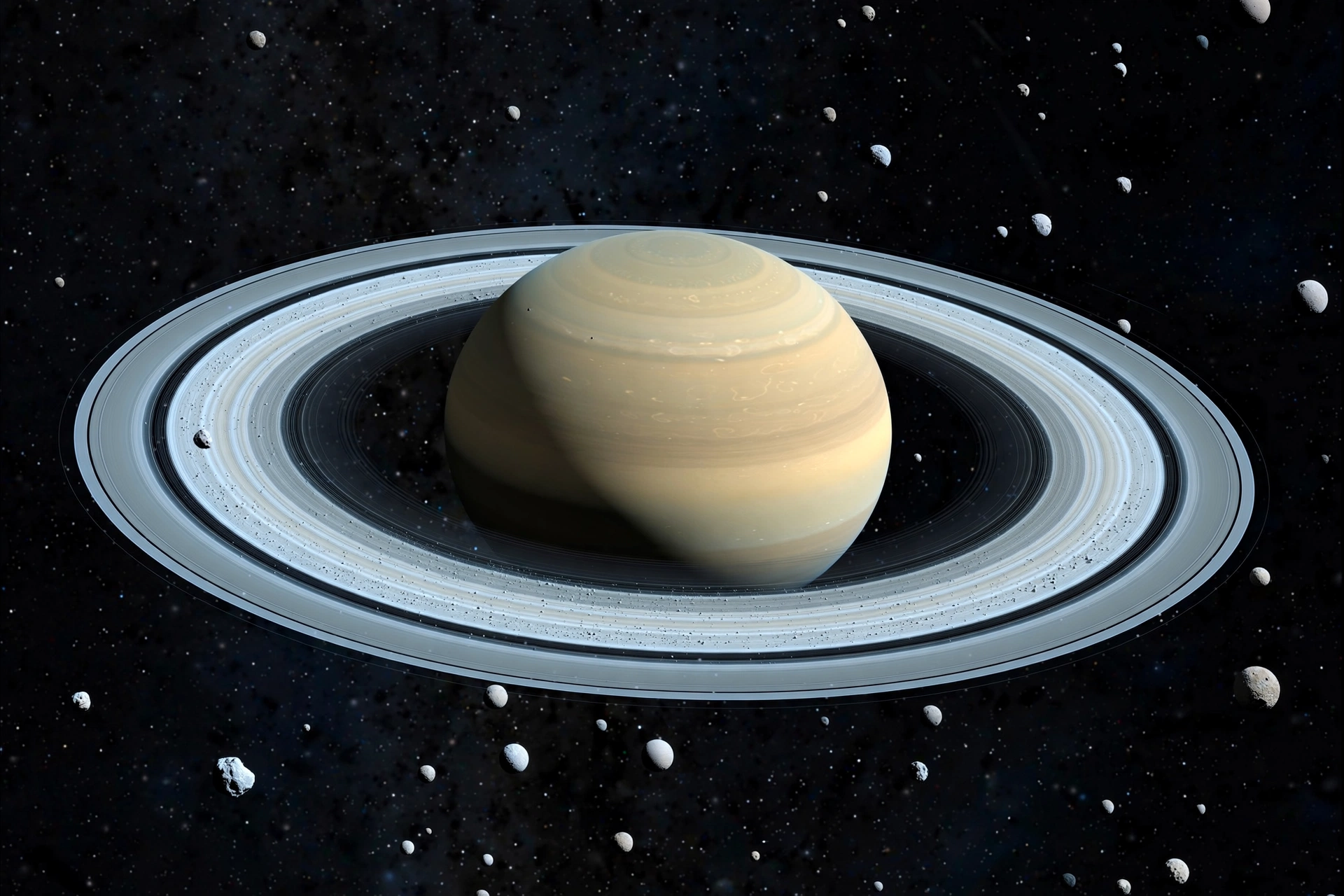
On paper, the news is a single number: Saturn now has 274 moons, after astronomers confirmed 128 new ones in a single announcement. Read more carefully, though, and the number is the least interesting part. The real story is what a complete census of small, battered, oddly orbiting moons reveals about how the outer solar system actually evolved: not in calm order, but through capture, collision and slow dispersal. The confirmation lifts Saturn from 146 moons to a total greater than every other planet’s moons combined, and it deserves analysis rather than mere applause.
The Evidence Behind the Headline
The discoveries rest on a multi-year survey with the Canada-France-Hawaii Telescope on Mauna Kea, with orbit work involving University of British Columbia researchers including Dr Edward Ashton, and formal recognition by the International Astronomical Union. That chain matters for credibility. The moons were detected in deep images, re-observed across seasons, and admitted to the official catalogue only once their orbits were beyond reasonable doubt. This is the astronomical equivalent of an audited figure, and it is why the jump to 274 should be treated as settled fact rather than a provisional estimate.
Our own analysis desk often returns to the same discipline in other fields, most recently in our examination of a fast-moving Washington crypto story where early claims needed careful checking. The Saturn announcement passes that test: named institutions, a published method, and a recognising body with no incentive to inflate the count.
Reading the Orbits Like a Record
The new moons are irregular: a few kilometres across, far from the planet, on orbits tilted steeply against Saturn’s equator, and frequently retrograde, moving against the direction of planetary rotation. Each of those traits is evidence. Locally formed moons inherit the orderly motion of the disc that built them. Captured bodies keep the disorder of their arrival. A retrograde, tilted swarm is therefore a signature of theft: Saturn’s gravity collected passing objects over immense spans of time, and the present census is partly a catalogue of those acquisitions.
The clustering is equally informative. Many new moons share near-identical orbital characteristics, forming families that astronomers interpret as the debris of larger captured moons destroyed by impacts. By measuring how far each family has spread, researchers can estimate when the parent body broke apart. In effect, the moons function as a distributed fossil record, and 128 new specimens materially improve the statistics of that record.
Shift and Stack: Method as Message
The detection technique, shift and stack, deserves attention because it explains why this census arrived now. Astronomers shifted successive deep images to track a moon’s expected motion and stacked them, allowing a few-kilometre object to emerge from noise while stars smeared into trails. The method rewards exactly what modern astronomy increasingly possesses: large archives of images and the computing power to interrogate them repeatedly. The Canada-France-Hawaii Telescope archive, worked over several years, contained moons that no single night’s observing could have certified.
There is a broader lesson here for how science progresses. The limiting factor was not the existence of the moons, nor even their first appearance in data, but the follow-up needed to prove their orbits. Discovery, in this field, is a verification pipeline. The UBC science programme that contributed to the work illustrates a model of astronomy in which patience and computation matter as much as aperture.
What the Census Changes
First, it recalibrates comparison. Jupiter’s 95 moons once looked competitive; Saturn’s 274 reframes the question from which planet has most to why Saturn’s capture-and-collision history produced such abundance. Second, it constrains models of the early outer solar system, where migrating giant planets scattered small bodies in vast numbers. A Saturn that captured prolifically, then shattered some of its prizes, fits that turbulent picture neatly. Third, it sets an expectation: if shift-and-stack surveys keep deepening, the count may rise again, and each rise will refine, not merely extend, the historical record written in these small worlds’ orbits.
