
The quest to find life beyond Earth has fascinated humanity for centuries. From ancient myths to modern science, the possibility that we are not alone in the universe continues to inspire curiosity and innovation.
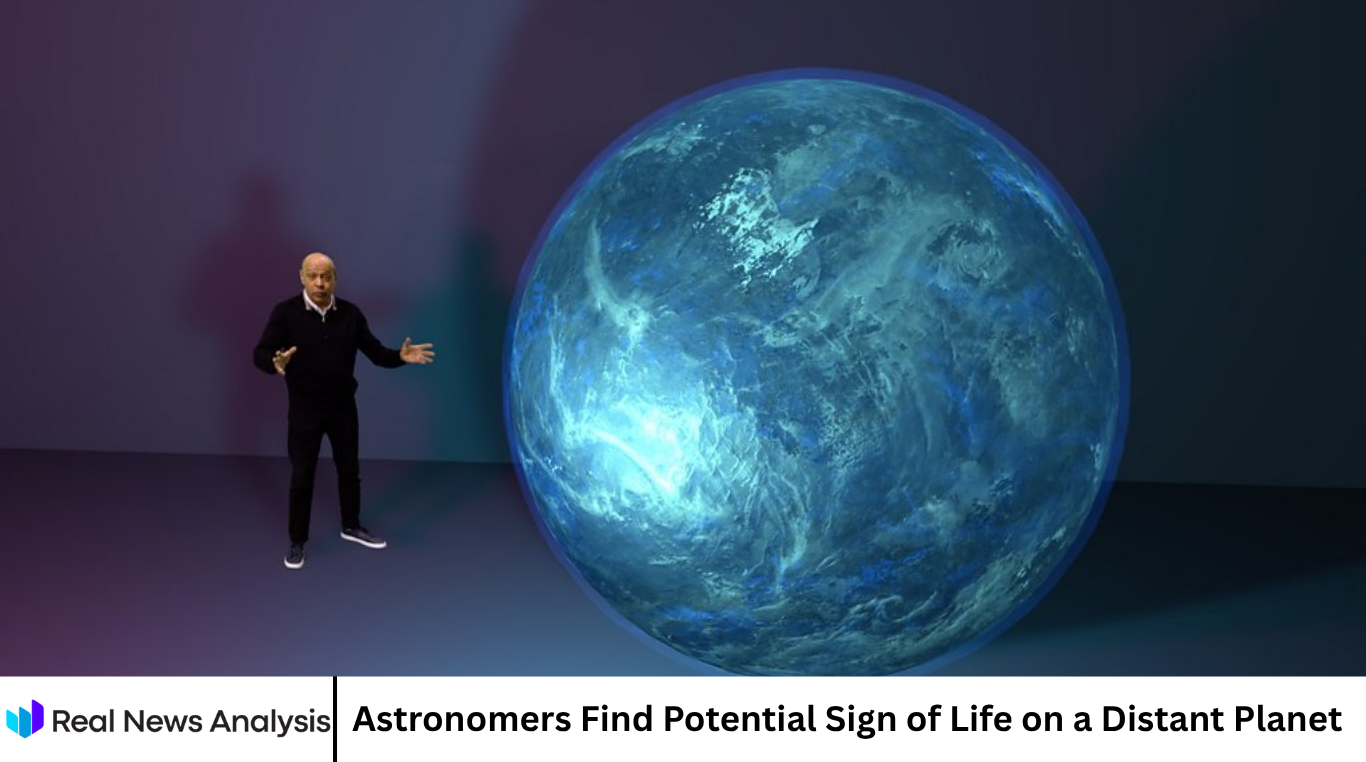
Recently, astronomers have made an exciting discovery that could bring us closer to answering this profound question. Scientists have detected a potential sign of life on a distant planet, sparking hope and intense scientific debate across the globe.
More Read: Refining Climate Models to Guide Responses to Tipping Point Threats
Understanding the Search for Life Beyond Earth
The search for extraterrestrial life revolves primarily around identifying biosignatures—indicators that suggest the presence of living organisms. These biosignatures can take many forms, including specific chemicals, atmospheric gases, or unusual environmental patterns that are difficult to explain through non-biological processes.
The vastness of space presents enormous challenges. Stars are scattered across billions of light-years, and planets orbiting those stars are often too distant or faint to observe directly with current technology.
However, recent advances in telescopes, spectroscopy, and data analysis techniques have allowed astronomers to peer deeper into the cosmos and gather more precise information about exoplanets—planets outside our solar system.
The Discovery: A Potential Biosignature on a Distant World
The recent discovery centers on a planet located in the habitable zone of its star—the region where conditions could support liquid water, a key ingredient for life as we know it. Using advanced space-based telescopes equipped with spectrometers, astronomers analyzed the planet’s atmosphere and found traces of gases that may indicate biological activity.
Among the detected gases were methane and oxygen, an unusual combination because they tend to react and cancel each other out. Their coexistence suggests that something may be actively replenishing these gases. On Earth, this kind of balance is primarily maintained by living organisms, making it a tantalizing clue for scientists.
What Makes This Discovery Important?
Finding potential signs of life on a distant planet is a milestone in the search for extraterrestrial biology. It provides a concrete target for future studies and a framework for understanding how life might arise and persist in different environments.
While methane and oxygen can be produced through non-biological processes, the balance observed raises questions that cannot be easily dismissed. Scientists now have a real candidate for further exploration, with hopes that future observations and missions will either confirm or refute these initial findings.
The Tools Behind the Discovery
This achievement was made possible through a combination of cutting-edge instruments and innovative methods. Space telescopes such as the James Webb Space Telescope and the Hubble Space Telescope have contributed significantly by providing detailed spectra of exoplanet atmospheres.
Spectroscopy allows astronomers to detect the unique signatures of molecules based on the way they absorb or emit light. By analyzing the light passing through or reflected by a planet’s atmosphere, researchers can identify which gases are present and in what quantities.
In addition to telescopes, computer models and simulations play a vital role in interpreting the data. These models help scientists understand the possible sources of gases and rule out false positives caused by natural but non-biological processes.
Challenges and Limitations
Despite the excitement, this discovery is not definitive proof of life. Many challenges and uncertainties remain. For example, certain geological or photochemical processes could mimic biosignatures. The planet’s environment and star type might also influence atmospheric composition in unexpected ways.
Moreover, the detection itself is based on indirect measurements. No direct images or samples from the planet’s surface exist, making confirmation difficult. Future missions and improved technology will be needed to build on this foundation.
The vast distances also mean that even if life exists there, communicating or traveling to the planet remains beyond current capabilities. Still, the discovery expands our understanding of where and how life might exist in the universe.
Implications for Astrobiology
This finding energizes the field of astrobiology, the study of life in the universe. It encourages scientists to refine their search strategies, develop new instruments, and revisit assumptions about the conditions necessary for life.
Astrobiologists now face the exciting challenge of determining how common such biosignatures are and whether similar planets exist closer to Earth. It also prompts philosophical questions about the nature of life and its potential diversity.
The Future of Exoplanet Exploration
With the discovery of a potential life signature on a distant planet, the future of exoplanet exploration looks promising. Upcoming missions aim to study exoplanets in greater detail, focusing on habitability and signs of life.
New telescopes and observatories are being planned, with improved sensitivity and broader spectral coverage. These tools will enable scientists to observe more planets and distinguish between biological and non-biological signals more accurately.
In addition, international collaboration and private space ventures are accelerating research and technological development, making the search for extraterrestrial life a global endeavor.
Frequently Asked Questions
What is a biosignature?
A biosignature is any substance or phenomenon that provides scientific evidence of past or present life. This can include specific gases like oxygen or methane in an atmosphere, organic molecules, or patterns in the environment that are unlikely to occur without biological processes.
Why is the combination of methane and oxygen significant?
Methane and oxygen react with each other and typically don’t coexist for long without a replenishing source. On Earth, living organisms continually produce these gases, maintaining their presence in the atmosphere. Finding both in an exoplanet’s atmosphere suggests there might be an active process, potentially biological, producing them.
Could the detected gases come from non-biological sources?
Yes. Volcanic activity, chemical reactions, or stellar radiation can sometimes produce gases like methane and oxygen. Scientists must carefully analyze data and consider all possible explanations to avoid false positives.
How do astronomers detect gases on distant planets?
Astronomers use a technique called spectroscopy, which studies how light interacts with matter. When a planet passes in front of its star, some of the starlight filters through its atmosphere, imprinting signatures of gases present. Instruments onboard space telescopes analyze this light to identify those gases.
What is the habitable zone?
The habitable zone, often called the “Goldilocks zone,” is the region around a star where temperatures allow liquid water to exist on a planet’s surface. It is considered essential for life as we know it, although life might exist in other conditions.
Why is this discovery not definitive proof of life?
The evidence is based on atmospheric analysis, which is indirect. Other natural processes can create similar signatures, and without direct observation or sampling, it’s impossible to confirm biological activity conclusively.
What are the next steps after this discovery?
Scientists plan to conduct further observations using more powerful telescopes and instruments. They will also develop better models to understand atmospheric processes and design future missions that might capture more detailed data or even images of such planets.
Conclusion
The detection of a potential sign of life on a distant planet marks a remarkable milestone in humanity’s search for extraterrestrial life. Although the evidence is not conclusive, it opens new pathways for exploration and scientific inquiry. It challenges our understanding of life’s potential in the universe and inspires continued innovation in technology and research.As telescopes grow more sophisticated and data accumulates, we may soon move from hints and possibilities to direct evidence of life beyond Earth. Until then, discoveries like this remind us of the vastness of the cosmos and the exciting mysteries still waiting to be unraveled.
