
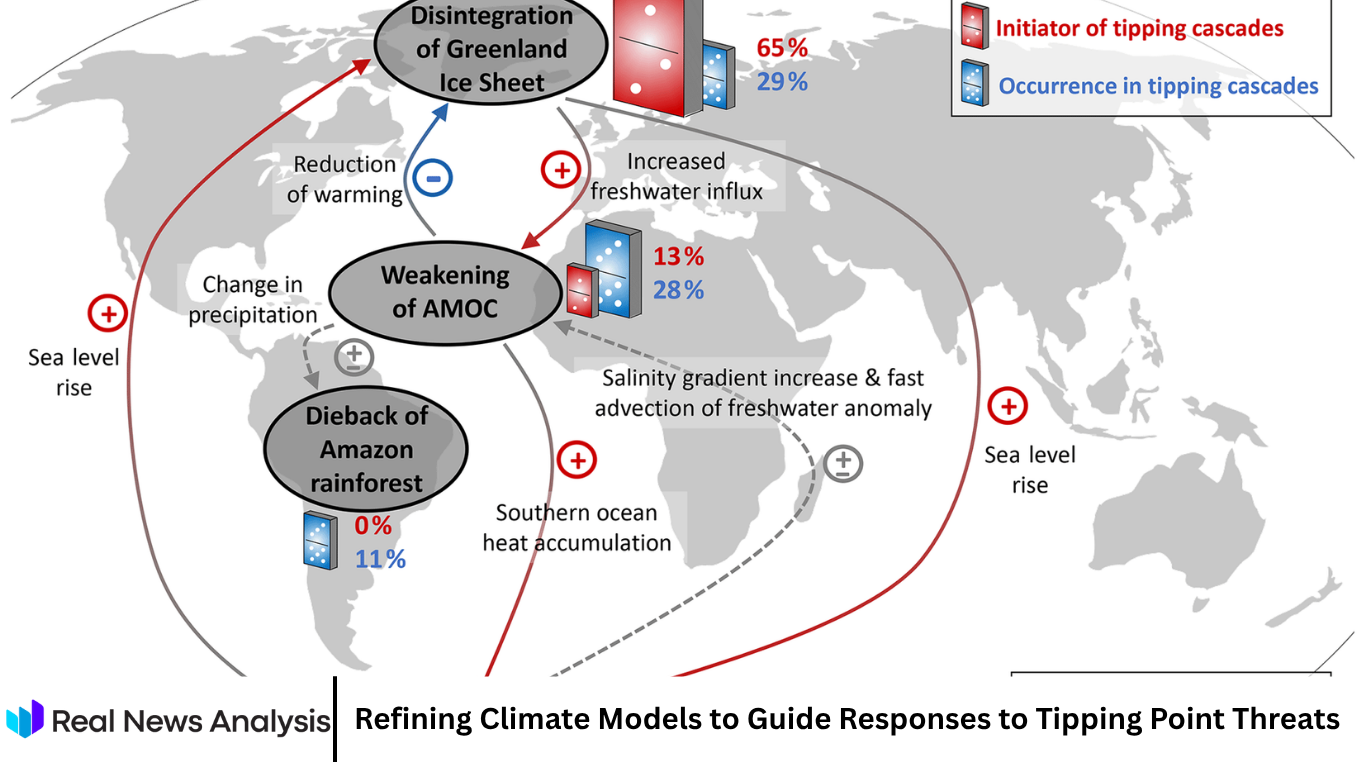
The urgency of addressing climate change has grown significantly in recent years, driven in part by the recognition that certain changes in the Earth’s systems may become irreversible once specific thresholds, or “tipping points,” are crossed.
These tipping points include melting ice sheets, deforestation in the Amazon, or changes to major ocean currents—each with the potential to drastically alter global climates and ecosystems. Understanding when and how these events may occur is critical. One of the most effective tools in our climate science arsenal is the use of climate models.
Climate models simulate the behavior of the Earth’s climate systems, offering insights into possible future scenarios under different conditions. However, traditional climate models, while invaluable, face challenges in capturing the nonlinear, abrupt, and sometimes irreversible nature of tipping points. As a result, scientists are working to refine these models, making them more accurate and useful for anticipating and responding to these complex risks.
More Read: India’s breakthrough drugs fight against deadly superbugs
What Are Climate Tipping Points?
Climate tipping points refer to critical thresholds in the Earth’s systems, beyond which small changes can lead to dramatic and often irreversible shifts in the state of the system. These are not merely theoretical. Paleoclimate records show past examples, such as rapid shifts in temperature and precipitation due to sudden changes in ocean circulation or ice coverage.
Examples of potential tipping points include:
- The collapse of the Greenland and West Antarctic ice sheets
- Disruption of the Atlantic Meridional Overturning Circulation (AMOC)
- Dieback of the Amazon rainforest
- Thawing of Arctic permafrost releasing methane
- Melting of Himalayan glaciers affecting water supplies
Each of these systems plays a major role in maintaining global climate stability. Crossing one tipping point may even trigger others, in what some researchers call a “tipping cascade.”
The exact threshold for each tipping point is uncertain, which makes early detection and modeling essential for risk management and policy responses.
The Role of Climate Models
Climate models are mathematical representations of the Earth’s atmosphere, oceans, ice, land surface, and biosphere. They are built using physical laws and equations that simulate the flow of energy and matter within and between these systems.
Models range in complexity from simple energy balance models to fully coupled Earth system models. The latter incorporate complex interactions among climate, ecosystems, and human activities.
These models are used to simulate past, present, and future climate conditions under different emission scenarios. Policymakers, scientists, and environmental planners rely on them to make informed decisions about mitigation and adaptation strategies.
However, current models face limitations when it comes to tipping points. These events involve rapid changes and feedback loops that may not be well captured by standard modeling frameworks.
Challenges in Modeling Tipping Points
Refining climate models to better represent tipping points involves addressing a number of scientific and technical challenges:
Nonlinear Feedbacks: Tipping points often involve feedback loops, such as the ice-albedo feedback, where melting ice reduces reflectivity, increasing heat absorption and accelerating further melt. Modeling such nonlinearities accurately is complex.
Data Limitations: Observational data for tipping elements is sparse or inconsistent. The Arctic permafrost, for example, spans vast and remote regions, making consistent measurement difficult.
Temporal and Spatial Resolution: Tipping points may occur over decades or centuries, and often at regional scales. Many global climate models lack the resolution needed to capture localized dynamics.
Uncertainty in Thresholds: The exact point at which a system will tip is not always known. This uncertainty makes it difficult to simulate scenarios with precision.
Interconnectedness: Earth systems are deeply interconnected. A tipping event in one area, such as the Arctic, can influence systems elsewhere. Capturing these interdependencies requires complex coupling in models.
Computational Constraints: More detailed models require greater computational power. High-resolution simulations over long time periods are resource-intensive.
Despite these challenges, progress is being made. New modeling techniques, better data integration, and increasing computational capabilities are all helping to refine climate models.
Advances in Climate Model Refinement
Efforts to refine climate models to assess tipping point threats focus on multiple fronts:
High-Resolution Modeling: Advances in computing have allowed for finer resolution models that can capture regional tipping elements, such as glacial melting or forest dieback, with greater accuracy.
Coupled Earth System Models: These integrate atmospheric, oceanic, cryospheric, and biospheric components. Recent models now include dynamic ice sheet models and vegetation dynamics, helping simulate feedback processes.
Paleoclimate Data Integration: Using historical climate data from ice cores, sediment layers, and tree rings provides insights into past tipping events, which can inform model development.
Machine Learning and AI: Machine learning is increasingly being used to analyze large climate datasets, detect patterns, and improve parameterization in models. AI can help identify early warning signs of tipping points.
Probabilistic Modeling: Rather than deterministic outcomes, refined models now often include probabilistic approaches to account for uncertainty. This is crucial for risk assessment and scenario planning.
Early Warning Systems: Refined models can be integrated into early warning systems that detect changes in key indicators, such as slowing ocean currents or increased methane emissions from permafrost.
Scenario Testing: Models can simulate various emission pathways and their potential to trigger tipping points, helping policymakers understand the risks associated with different climate futures.
The Role of Policy and Decision Making
One of the main goals of refining climate models is to make them more actionable. This means translating model outputs into information that governments, organizations, and communities can use to make decisions.
For example:
- Cities vulnerable to sea level rise from polar ice melt can use model forecasts to plan infrastructure investments.
- Nations can design emission reduction targets aligned with pathways that minimize tipping point risks.
- Agricultural planners can adjust crop strategies based on model predictions of precipitation and temperature shifts.
Models also help international bodies like the Intergovernmental Panel on Climate Change (IPCC) provide assessments that guide global climate agreements and adaptation planning.
However, communication is key. Scientists must convey uncertainties clearly without diminishing the urgency of action. Scenario-based modeling can help by illustrating a range of outcomes and the benefits of precautionary approaches.
Ethical and Societal Implications
Beyond technical and policy considerations, the refinement of climate models carries ethical and societal dimensions.
- Justice and Equity: Populations least responsible for emissions often face the greatest risks from tipping points. Improved models can help ensure climate finance and adaptation resources are allocated fairly.
- Intergenerational Responsibility: Decisions made today have long-term consequences. Modeling helps quantify the risks future generations may inherit, reinforcing the ethical imperative for current action.
- Public Engagement: As tipping points are difficult to understand and easy to dismiss, refined models can help make the science more accessible, fostering public support for climate action.
By improving the accuracy and accessibility of models, scientists can support more inclusive and effective responses to climate threats.
Future Directions in Climate Modeling
Looking ahead, several promising directions may further enhance the ability of models to anticipate and respond to tipping points:
- Integrated Assessment Models (IAMs): These combine climate science with economic and social data, helping policymakers weigh trade-offs and co-benefits.
- Regional Downscaling: Providing local-level projections from global models allows for more targeted adaptation planning.
- Real-Time Monitoring Integration: Combining models with satellite and sensor data can create dynamic systems that update predictions as conditions change.
- Open-Source and Collaborative Platforms: Initiatives that allow scientists worldwide to contribute to and improve models accelerate innovation and democratize knowledge.
The refinement of climate models is an ongoing process, vital to humanity’s capacity to anticipate, mitigate, and adapt to one of the most significant threats of our time.
Frequently Asked Questions
What is a climate tipping point?
A climate tipping point is a critical threshold at which a small change in environmental conditions can lead to large, often irreversible shifts in the climate system.
Why are tipping points hard to model?
They involve complex feedback loops, uncertain thresholds, and interconnected systems, which require high-resolution data and advanced simulation techniques.
How can refined models help in real-world planning?
They can provide more accurate forecasts, allowing for better infrastructure design, disaster preparedness, and climate policy development.
Are current models reliable enough?
While current models are useful, refining them helps improve accuracy, especially regarding abrupt or nonlinear changes like tipping points.
Can refining models prevent tipping points?
Models themselves don’t prevent tipping points but help identify risk thresholds, allowing timely action to reduce emissions or adapt policies.
What role does artificial intelligence play in refining models?
AI helps process vast datasets, detect early warning signals, and optimize model performance, making simulations more efficient and informative.
How soon could a tipping point occur?
Some tipping points, such as ice sheet loss or coral bleaching, may already be underway. Timing depends on future emissions and global responses.
Conclusion
The threat of climate tipping points represents one of the gravest challenges in the fight against climate change. These abrupt and potentially irreversible shifts can dramatically alter the planet’s climate system, threatening biodiversity, food security, and the livelihoods of billions
