
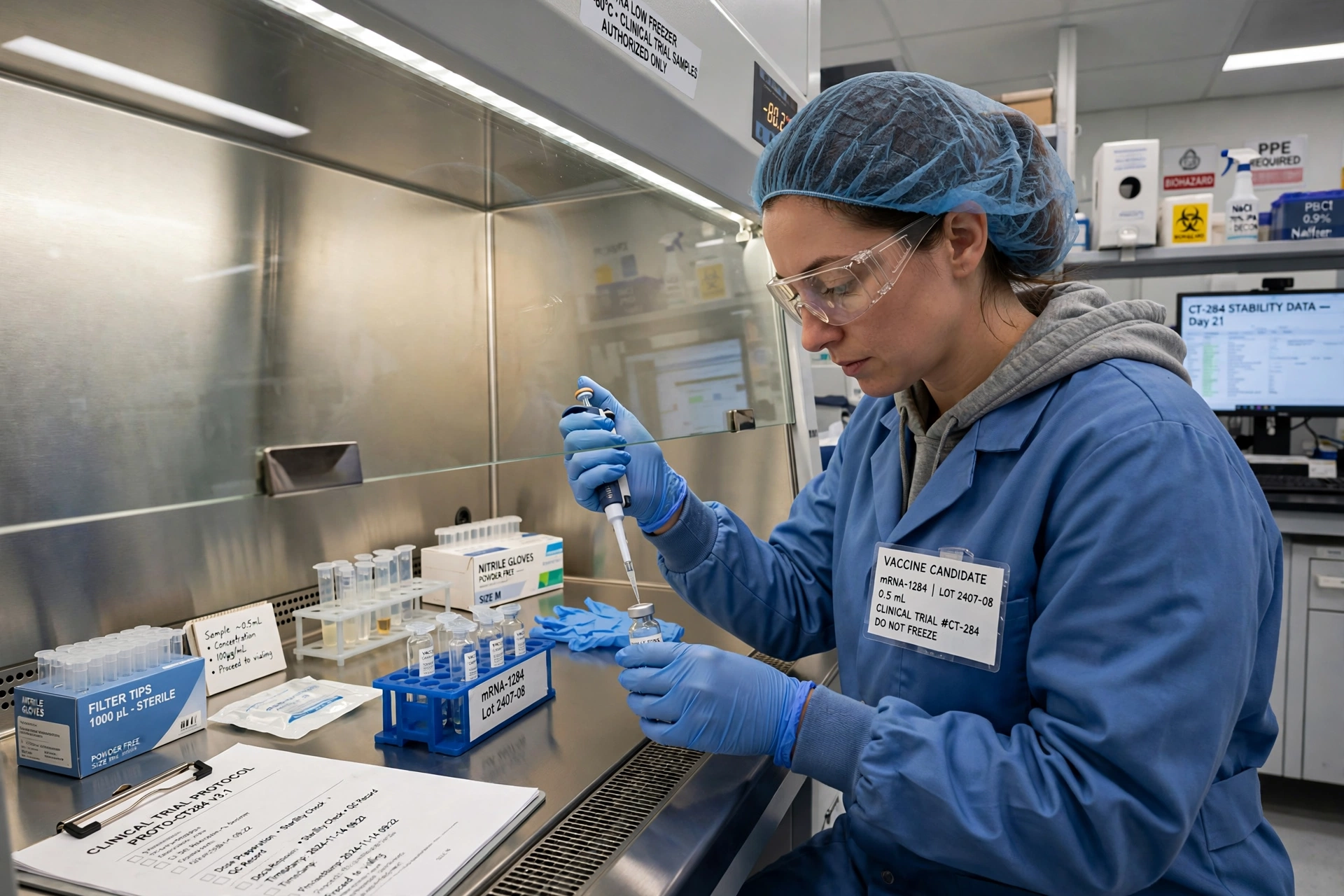
The most important sentence in the NeoVax story is the least dramatic one: it could be done. A phase 1 trial, published in Nature Medicine, has shown that a personalised neoantigen vaccine, designed from each patient’s own tumour mutations and combined with the PD-1 inhibitor nivolumab, could be manufactured and administered to people with platinum-sensitive recurrent ovarian cancer, with acceptable safety and measurable immune responses. Analysis of the result requires resisting two temptations at once: the hype that converts any vaccine headline into a cure story, and the cynicism that dismisses feasibility work as meaningless. Neither survives contact with what the trial actually tested.
The Logic of the Intervention
NeoVax exploits a genuine asymmetry between cancer and healthy tissue. Mutations accumulate in tumours, and some generate neoantigens, protein fragments found only on the cancer. A vaccine built from a patient’s selected neoantigens aims to train T cells to recognise and attack cells displaying them. Nivolumab’s role is to block PD-1, a checkpoint that can restrain those same T cells. The combination is therefore sequential in concept: educate the immune system, then remove one of its brakes. That coherence is a point in the approach’s favour, though coherent mechanisms fail in medicine often enough that mechanism alone proves nothing.
Our analysis coverage applies the same distinction between plausible mechanism and proven outcome elsewhere, including in our recent deep look at Federal Reserve wealth data and what it does and does not show. NeoVax currently sits firmly on the shown side only for feasibility, safety and immune activation.
Reading the Results at Face Value
The trial’s population was narrow and clinically specific: recurrent ovarian cancer that remained platinum-sensitive. Within that group, the published findings in Nature Medicine are that personalised vaccines were successfully produced and delivered alongside nivolumab, tolerability was acceptable, and T-cell responses against targeted neoantigens were observed. Each element answers a real prior uncertainty. Bespoke manufacturing could have failed on timing or quality. The combination could have produced unacceptable toxicity. Vaccination could have left no detectable immune trace. None of those failure modes occurred, which is precisely the information a phase 1 trial exists to provide.
What the data cannot support is any statement about efficacy. The study was small, early and not structured to measure survival or comparative benefit. Treating immune response as a proxy for clinical success would be an analytical error: immunology offers many examples of measurable responses that did not translate into better outcomes for patients.
Why Feasibility Is Not a Consolation Prize
Personalised therapies face a structural challenge that conventional drugs do not: the product is a process. Every NeoVax dose begins with a particular tumour’s mutation profile, which means quality, speed and cost must be demonstrated patient by patient. By showing the process can run end to end in a real trial population, this study de-risks the platform in a way that matters to every subsequent research decision, from funding larger trials to designing manufacturing at scale. Resources catalogued by the National Institutes of Health reflect how central such translational steps are in moving laboratory concepts towards tested medicines.
There are also honest constraints to record. Bespoke production is inherently slower and more expensive than mass manufacture, and recurrent ovarian cancer moves quickly in many patients. Whether the pipeline can be made fast and affordable enough to matter clinically is an open engineering and economics question, not a detail.
A Measured Verdict
The balanced conclusion is that NeoVax plus nivolumab has cleared the first gate in a long evaluation: it is feasible to make, acceptable to give, and immunologically active in the intended way, in a small group of patients with a difficult, recurring cancer. The next gates, larger controlled trials with clinical endpoints, will decide whether it deserves a place in treatment. Readers should hold both truths together: this is real progress of a specific, limited kind, and it is not evidence of a cure. In a field crowded with premature celebration, the trial’s own restraint may be its most credible feature.
